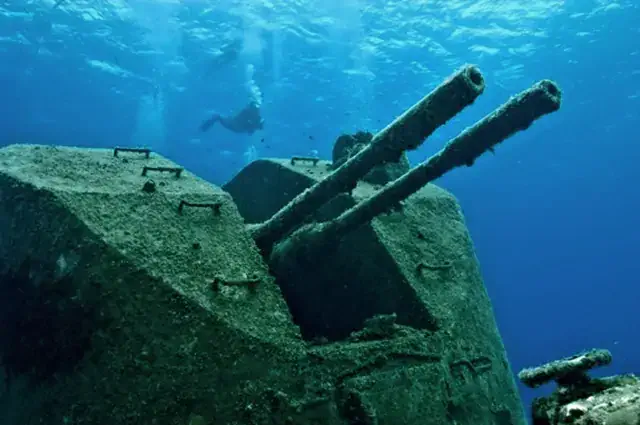
USAT Meigs
Darwin, NT
USAT Meigs
By ScubaDownUnder Team · 2026-05-29
The USAT Meigs was the largest vessel in Darwin Harbour when Japanese aircraft attacked on 19 February 1942, according to the Australasian Underwater Cultural Heritage Database (AUCHD). She is no longer a standing ship. Salvors cut away her superstructure and upper hull in 1959 and 1960, and what divers find today is about 120 metres of ship floor and lower hull, upright in 18.5 metres, with the army cargo she never delivered still lying in her holds.
## From West Lewark to Meigs
She was built in 1921 at San Pedro, California, as the West Lewark, a 12,568 ton steel cargo steamer for the United States Shipping Board. The US Army bought her in 1922, renamed her Meigs and used her through the interwar years to carry freight and animals around the Pacific.
In late 1941 she sailed from San Francisco in a convoy bound for the Philippines. War with Japan diverted it to Australia, and the Meigs reached Darwin in January 1942. On 15 February she left with the Mauna Loa, Tulagi and Portmar, escorted by USS Houston and USS Peary, to carry supplies and reinforcements to Kupang for the defence of Timor. Japanese aircraft attacked the convoy twice and it turned back to Darwin on 17 February.
## The raid and the salvors
Two days later the Meigs was moored in Port Darwin, still loaded with ammunition and equipment of the Australian Army's 2nd and 4th Pioneer Regiments, including trucks, light vehicles and armoured vehicles. The first raiders arrived over Darwin at 9.58 am, in what remains the largest single attack ever mounted by a foreign power on Australia. The Meigs was hit several times, caught fire and sank, one of at least seven large ships sunk in the harbour that day.
In 1947 the Commonwealth sold the wreck to Carl Atkinson of Darwin, who recovered a little cargo, including three Chevrolet trucks, before customs duties on each vehicle ended the venture. In 1958 he sold her to the Fujita Salvage Company of Japan. In 1959 and 1960 Fujita's divers cut the wreck apart with dynamite and underwater gas torches, and the superstructure, upper hull, upper decks, engines and boilers went for scrap. A blade from the Meigs's propeller marked the grave of the company's president, Ryugo Fujita, in Japan until 2017, when it was returned to Darwin.
## The wreck today
AUCHD's description, from a 2011 inspection, is the best guide to what is down there. The ship lies upright on her keel with the bow pointing south-south-east. At the bow, ribs and hull plating rise one to two metres off the seabed, and the very end of the bow is torn away, leaving a passage to swim through beside a row of large gas cylinders.
In what was the forward hold lie I-beams and a collection of military projectiles that dive instructors reportedly gathered from elsewhere on the wreck to show their students, with .303 ammunition scattered in front of the first bulkhead. Against the back of that bulkhead sits a Universal Carrier, the tracked "Bren gun carrier", its body, wheels and tracks intact.
The second hold has at least two rows of vehicles, mostly bare chassis now, lined up side by side as they were stowed, plus the remains of a fire truck and tyres rising out of the sand where more vehicles are buried. Depth charges, or possibly land mines, lie on the seabed off its starboard side. The third hold, probably the engine room area, is strewn with bricks, more than 15 large cylinders, a small rail cart and a bundle of battlefield communication wire.
Plenty has gone. AUCHD notes that divers have removed cargo over the decades, including the carrier's headlights and the fire truck's brass nozzles. Some of what is left is live ordnance. Look, photograph and touch nothing.
## Conditions
The Meigs lies in the open harbour about a kilometre north of the [SS Mauna Loa](https://scubadownunder.com/blog/ss-mauna-loa), going by their AUCHD positions. Port Darwin's tides reach a maximum range of 7.8 metres, with a mean spring range of 5.5 metres and a mean neap range of 1.9 metres, and the currents they drive are complex and strong. Wikipedia's article on the ship says it is only divable around neap tides.
No visibility figures are published for the Meigs itself. For the Mauna Loa nearby, the NT Heritage Branch says visibility rarely exceeds two to three metres even on a well-planned day, while 50 Great Dives gives 5 to 15 metres and a water temperature of 27 to 30°C, and rates the dry season best.
Box jellyfish are most likely in NT waters from 1 October to 1 June, but stings have been recorded in every month: cover your skin, and know that NT first aid for a sting is vinegar, never fresh water. Saltwater crocodiles are abundant in the Territory again, and the Parks and Wildlife Commission runs a crocodile survey and trapping program in Darwin Harbour itself.
Dive Darwin lists turtles, sharks, dolphins and manta rays among the animals seen on its harbour wreck tours, and Tourism NT adds schooling fish, nudibranchs and cuttlefish. Come for the history, though: this is a dark, silty wreck in moving water.
## Site Access and Logistics
The Meigs is a boat dive in a working port. [Dive Darwin](https://www.divedarwin.com.au) runs five-hour guided harbour wreck tours from Dock 2, Stokes Hill Wharf (Sea Darwin Cruises), 7am to 12 noon, visiting two of the harbour's roughly 90 wreck sites. Scuba gear, a guide, permits and lunch are included, groups are capped at nine, and in October 2026 the tour was listed from AUD $440. The booking page does not say which wrecks, so ask if you want the Meigs. Dive Darwin requires PADI Advanced Diver certification and a minimum age of 15.
AUCHD lists the Meigs as protected under the Northern Territory Heritage Act and the Commonwealth Underwater Cultural Heritage Act 2018. Under the Commonwealth Act you must not disturb, damage or remove anything, and any new find must be reported within 21 days. For any dive outside an operator's permitted tour, ask the NT Heritage Branch (08 8999 5039, heritage.branch@nt.gov.au) first.
The Larrakia people are the Traditional Owners of Darwin Harbour. The [Darwin Harbour Wrecks](https://scubadownunder.com/dive-sites/darwin-harbour-wrecks) site page covers the harbour's other raid wrecks.
## Sources
- [AUCHD: USAT Meigs](https://www.environment.gov.au/shipwreck/public/wreck/wreck.do?key=3505) - [AUCHD: USAT Mauna Loa](https://www.environment.gov.au/shipwreck/public/wreck/wreck.do?key=3503) - [Library & Archives NT: The Fujita Salvage Operation](https://lant.nt.gov.au/explore-nt-history/fujita-salvage-operation) - [Wikipedia: USAT Meigs](https://en.wikipedia.org/wiki/USAT_Meigs) - [Wikipedia: Bombing of Darwin](https://en.wikipedia.org/wiki/Bombing_of_Darwin) - [Wikipedia: Darwin Harbour](https://en.wikipedia.org/wiki/Darwin_Harbour) - NT Heritage Branch: U.S.A.T. Mauna Loa brochure (PDF, linked from the NT Government maritime heritage page) - [50 Great Dives: USAT Mauna Loa (1942)](https://50greatdives.com/auswreckx/entry/188/) - NT Government: Box jellyfish (nt.gov.au/wellbeing/emergencies-injuries-and-accidents/bites-and-stings/box-jellyfish) - Be Crocwise, NT Government: Saltwater crocodile policy (becrocwise.nt.gov.au/crocodile-management/saltwater-crocodile-policy) - [DCCEEW: Visiting underwater cultural heritage sites](https://www.dcceew.gov.au/parks-heritage/heritage/underwater-heritage/visiting-underwater-heritage-sites) - [DCCEEW: Australasian Underwater Cultural Heritage Database](https://www.dcceew.gov.au/parks-heritage/heritage/underwater-heritage/auchd) - NT Government: Maritime heritage (nt.gov.au/leisure/arts-culture-heritage/visit-a-cultural-or-heritage-site/maritime-heritage) - Dive Darwin: Darwin Harbour Wreck Tours booking page (divedarwin1.rezdy.com/708255/darwin-harbour-wreck-tours) - [Dive Darwin: Home](https://www.divedarwin.com.au) - [Tourism NT: Dive Darwin Historic Wreck Diving Tour](https://northernterritory.com/tours/dive-darwin/dive-darwin-historic-wreck-diving-tour)
Header photo: The Meigs as the cargo ship West Lewark in port in June 1921, by an unknown US Navy photographer (Naval History and Heritage Command NH 102524), [Public domain, via Wikimedia Commons](https://commons.wikimedia.org/wiki/File:Usat_meigs.jpg).
Visibility at USAT Meigs
Visibility at USAT Meigs typically ranges from 3 to 12 metres, though it shifts with swell, wind and recent rainfall. May to October (dry season, surface conditions) generally offers the best conditions for diving here.