SS Mauna Loa
Darwin, NT
SS Mauna Loa
By ScubaDownUnder Team · 2026-05-29
The Mauna Loa is the best documented of Darwin Harbour's 1942 raid wrecks that divers still visit. 50 Great Dives features her, the Northern Territory Heritage Branch publishes a brochure on her, and the Australasian Underwater Cultural Heritage Database (AUCHD) records decades of recreational diving on her. Like the [USAT Meigs](https://scubadownunder.com/blog/usat-meigs), about a kilometre to the north, she was cut down by salvors in 1959 and 1960, so what you dive is a cargo floor with the cargo still on it, not a ship.
## A long working life
She was built in 1919 at San Pedro, California, as the West Conob, one of the steel West series cargo ships ordered by the United States Shipping Board for the First World War. By 1921 she had sailed around the world twice. From 1925 she carried cargo between the USA, South America, Australia and New Zealand, in 1928 she became the Golden Eagle, and in 1934 the Matson Navigation Company renamed her Mauna Loa, after the volcano on the island of Hawaii.
In November 1941 the US War Department chartered her, with seven other merchant ships, to carry supplies to the Philippines. After the attack on Pearl Harbor the convoy was sent to Australia, and she reached Darwin in mid-January 1942. In mid-February she sailed again with the Meigs, Tulagi and Portmar, escorted by USS Houston and USS Peary, to reinforce Timor. Japanese aircraft attacked the convoy twice and it turned back to Darwin on 17 February.
## The raid and the salvors
On 19 February the Mauna Loa was at anchor in Port Darwin with ammunition and equipment of the Australian Army's 2nd and 4th Pioneer Regiments aboard, including trucks, motorbikes and armoured vehicles. Two bombs reportedly went through an open cargo hatch. Fire broke out, her stern quickly went under, and she stayed partly afloat for another day until her forward holds flooded. Five of her 38 crew died and the rest reached shore in lifeboats. AUCHD describes the wreck as the grave of five merchant sailors.
The Commonwealth looked at salvaging her in 1942 and 1943 but gave up after recovering an anchor, cable and shackles. She was sold to Carl Atkinson of Darwin in 1947 and to the Fujita Salvage Company of Japan in 1958, and in 1959 and 1960 Fujita's divers removed her superstructure, most of her upper hull and decks, and her engines and boilers for scrap.
## The wreck today
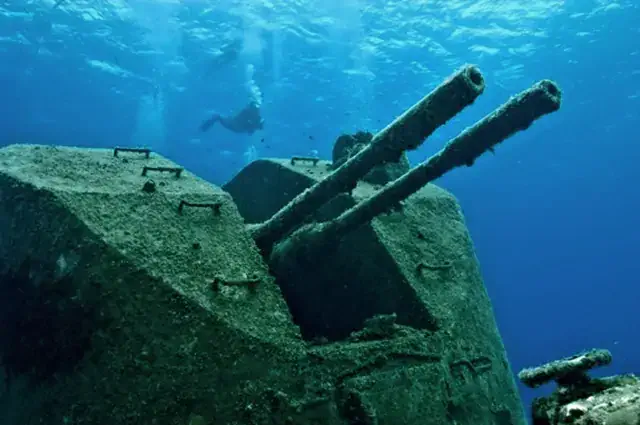
AUCHD describes the wreck lying upright on her keel, oriented north to south with the bow to the south, about 110 metres long. The bow is clearly recognisable and stands a little higher off the seabed than the stern, and the three cargo holds are still separated by the remains of bulkheads.
In the forward hold are military trucks and truck canopies, BSA and Royal Enfield motorbikes (some of them inside the trucks), Universal carriers and a trolley. The after hold holds .303 rifles, gas masks, 3 inch mortar bases and a large truck, and towards the stern lie more motorbikes, a winch and piles of .303 and .45 calibre ammunition and 3 inch mortars. Large uprights amidships appear to be the remains of mast bases, and bricks from the engine room lie towards the centre of the wreck.
The site has been picked over. Navy divers removed much of the heavier ammunition, including numerous unexploded mortar shells, in 1989, and AUCHD says recreational divers have taken cargo over the decades. In 2005 the Museum and Art Gallery of the Northern Territory returned a BSA motorbike to the wreck that the Navy had removed in 1991, labelled so it can be told apart from the others. Ammunition and mortars are still on the wreck: do not touch them.
50 Great Dives singles out the corals, some of them deep-water species growing on the wreck because so little light gets down. Dive Darwin lists turtles, sharks, dolphins and manta rays among the animals seen on its harbour wreck tours.
## Conditions
The NT Heritage Branch gives the depth as about 18 metres and AUCHD as 19 metres. The seabed is silty and easily stirred up by divers and tides, and the Heritage Branch says visibility rarely exceeds two to three metres even on a well-planned day. A 2023 dive account agrees it can drop that low, while 50 Great Dives gives 5 to 15 metres and a water temperature of 27 to 30°C. 50 Great Dives rates the Mauna Loa an Advanced dive and says the dry season is best.
Port Darwin's tides reach a maximum range of 7.8 metres, with a mean spring range of 5.5 metres and a mean neap range of 1.9 metres, and the currents they drive are complex and strong. Box jellyfish are most likely in NT waters from 1 October to 1 June, but stings have been recorded in every month: cover your skin, and know that NT first aid for a sting is vinegar, never fresh water. Saltwater crocodiles are abundant in the Territory again, and the Parks and Wildlife Commission runs a crocodile survey and trapping program in Darwin Harbour itself.
## Site Access and Logistics
The Mauna Loa is a boat dive in a working port, about 20 minutes by boat according to 50 Great Dives, which names [Dive Darwin](https://www.divedarwin.com.au) as its preferred operator for this wreck. Dive Darwin runs five-hour guided harbour wreck tours from Dock 2, Stokes Hill Wharf (Sea Darwin Cruises), 7am to 12 noon, visiting two of the harbour's roughly 90 wreck sites. Scuba gear, a guide, permits and lunch are included, groups are capped at nine, and in October 2026 the tour was listed from AUD $440. The booking page does not say which wrecks, so ask if you want the Mauna Loa. Dive Darwin requires PADI Advanced Diver certification and a minimum age of 15.
AUCHD lists the Mauna Loa as protected under the Northern Territory Heritage Act and the Commonwealth Underwater Cultural Heritage Act 2018. The Heritage Branch says divers may visit the site but must not damage, interfere with or remove any structure or object, and under the Commonwealth Act any new find must be reported within 21 days. For any dive outside an operator's permitted tour, ask the NT Heritage Branch (08 8999 5039, heritage.branch@nt.gov.au) first.
The Larrakia people are the Traditional Owners of Darwin Harbour. The [Darwin Harbour Wrecks](https://scubadownunder.com/dive-sites/darwin-harbour-wrecks) site page covers the harbour's other raid wrecks.
## Sources
- [AUCHD: USAT Mauna Loa](https://www.environment.gov.au/shipwreck/public/wreck/wreck.do?key=3503) - [AUCHD: USAT Meigs](https://www.environment.gov.au/shipwreck/public/wreck/wreck.do?key=3505) - NT Heritage Branch: U.S.A.T. Mauna Loa brochure (PDF, linked from the NT Government maritime heritage page) - [50 Great Dives: USAT Mauna Loa (1942)](https://50greatdives.com/auswreckx/entry/188/) - [Rodney Fox Shark Expeditions: Unveiling the SS Mauna Loa](https://rodneyfox.com.au/unveiling-the-ss-mauna-loa/) - [Wikipedia: SS Mauna Loa](https://en.wikipedia.org/wiki/SS_Mauna_Loa) - [Wikipedia: Darwin Harbour](https://en.wikipedia.org/wiki/Darwin_Harbour) - NT Government: Box jellyfish (nt.gov.au/wellbeing/emergencies-injuries-and-accidents/bites-and-stings/box-jellyfish) - Be Crocwise, NT Government: Saltwater crocodile policy (becrocwise.nt.gov.au/crocodile-management/saltwater-crocodile-policy) - [DCCEEW: Visiting underwater cultural heritage sites](https://www.dcceew.gov.au/parks-heritage/heritage/underwater-heritage/visiting-underwater-heritage-sites) - [DCCEEW: Australasian Underwater Cultural Heritage Database](https://www.dcceew.gov.au/parks-heritage/heritage/underwater-heritage/auchd) - NT Government: Maritime heritage (nt.gov.au/leisure/arts-culture-heritage/visit-a-cultural-or-heritage-site/maritime-heritage) - Dive Darwin: Darwin Harbour Wreck Tours booking page (divedarwin1.rezdy.com/708255/darwin-harbour-wreck-tours) - [Dive Darwin: Home](https://www.divedarwin.com.au) - [Tourism NT: Dive Darwin Historic Wreck Diving Tour](https://northernterritory.com/tours/dive-darwin/dive-darwin-historic-wreck-diving-tour)
Header photo: The Mauna Loa under her earlier name, Golden Eagle, in Vancouver on 13 July 1932, by Walter E. Frost, [CC0, via Wikimedia Commons](https://commons.wikimedia.org/wiki/File:SS_Golden_Eagle_in_Vancouver.jpg).
Visibility at SS Mauna Loa
Visibility at SS Mauna Loa typically ranges from 3 to 12 metres, though it shifts with swell, wind and recent rainfall. May to October (dry season) generally offers the best conditions for diving here.