Little Bay
Little Bay, NSW
Little Bay Shore Dive Guide, Sydney
By ScubaDownUnder Team · 2026-10-06
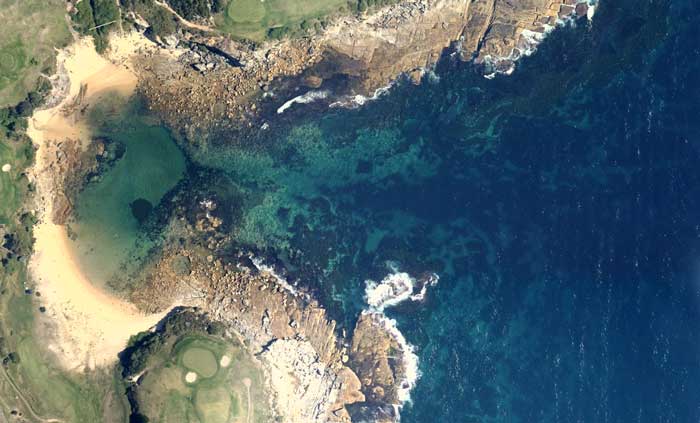
From the clifftop behind the old hospital chapel, Little Bay looks almost too small to dive: a sandstone horseshoe around a strip of golden sand, water the colour of bottle glass, and a narrow rocky mouth where the Tasman pushes in and runs out of steam. Then a diver wades in off the beach, sinks onto rippled sand and discovers that the bay is only the front door. Out past the mouth a reef wall runs east into deeper water, all overhangs, swim-throughs and gullies, with golf balls glinting in the cracks.
It is the dive Sydney locals keep up their sleeve for flat days: a soft sandy entry, a route that more or less navigates itself, and enough reef and fish to fill an unhurried hour. Michael McFadyen, who grew up in the suburb and has documented Sydney's dive sites for three decades, rates it "one of Sydney's easiest dives", with the walk back up the only real effort.
Little Bay lies on the eastern suburbs coast between Malabar and La Perouse, the last significant sand beach before Botany Bay. George Bass anchored his open whaleboat here on the evening of 3 December 1797 and called it Little Harbour. From 1881 the clifftops held the Coast Hospital, built during Sydney's smallpox outbreak and renamed Prince Henry Hospital in 1934; it once housed the state's only civilian recompression chamber, and its rebuilt war memorial chapel still overlooks the water. In 1969 the artists Christo and Jeanne-Claude wrapped 2.4 km of this coastline for their work Wrapped Coast. The bay sits outside the state's aquatic reserves (the nearest, Cape Banks Aquatic Reserve, is further south), while the La Perouse shore dives at [Bare Island](https://scubadownunder.com/blog/bare-island-dive-guide-sydneys-shore-diving-gem-in-botany-bay) and [Frenchmans Bay](https://scubadownunder.com/blog/frenchmans-bay-a-tranquil-gateway-to-sydneys-underwater-macro-world) lie just to the south, inside Botany Bay itself, and the grey nurse sharks of [Magic Point](https://scubadownunder.com/blog/magic-point-dive-site-guide) gather to the north off South Maroubra.
The dive begins on sand. From the southern beach, the larger and sandier of the bay's two little beaches, divers either snorkel towards the middle of the bay or drop straight down, then swim at right angles to the ripples in the sand, which leads them to the mouth. The floor here sits at about 3.5-5 m depending on the tide. Up and over the rocks of the entrance, the open ocean begins and the route is obvious: a modest wall on the right, the southern side, leads east and steps down through 5, 7 and 10 m. Along it are overhangs, a couple of swim-throughs and small gullies, with yellowtail, seapike and sweep working the reef, and luderick and eastern blackfish tucked into the overhangs closer to shore. At about 13 m the reef gives way to sand. A short run along the sand and a right turn brings divers to a rock platform cut with overhangs and small canyons, the most interesting part of the standard dive and about 25 minutes from the beach. On the way home, divers with air to spare cross the sand northwards to the reef on the far side and follow it back west, shallower, before slipping over the rocks into the bay and tracking the reef around to the beach.
Abyss lists eastern blue groper, cuttlefish, Port Jackson sharks and wobbegongs among the residents and visitors, set against rocky reef and kelp beds. The groper are the showpiece: big, friendly, curious fish that Abyss calls a regular companion on Sydney dives. They are strictly for looking at: line fishing for eastern blue groper is banned in NSW, a prohibition continued for a further three years from 1 March 2025. Abyss also notes that Port Jackson sharks and giant cuttlefish are cooler-month regulars on Sydney reefs, so the cooler half of the year is the best bet for both. Wobbegongs are worth looking for under the ledges, where they rest and blend into the reef.
Little Bay's shelter is real, but it ends at the mouth. The bay faces east, and its entrance is shallow and rocky, a place where bigger waves break even while the beach inside is lapping quietly. A strong sea from the south or south-east is the classic spoiler, running into the bay and setting up a rip that is otherwise absent. Because the route crosses that shallow entrance twice, the dive needs fairly flat seas, and the sensible routine is to look down on the bay from behind the chapel before gearing up. Westerly and north-westerly winds flatten Sydney's seas, though McFadyen notes it can take a day or more for a swell above 2 m to drop away. There is no long-term visibility record for Little Bay itself; across Sydney, McFadyen's log of more than 1,700 Sydney dives shows winter delivering the clearest water, June best of all, and October and November the murkiest, with around half of all dives better than 10 m. The beaches south of Malabar became markedly cleaner soon after the Malabar deep ocean outfall began operating in 1990. Stormwater from surrounding streets still drains onto the beach, and the standing Beachwatch advice is to stay out of the water during and for 24 hours after heavy rain. Water temperature runs from about 17 °C in late winter and early spring to around 25 °C in late summer and early autumn; many Sydney divers wear 5-7 mm, and a hood makes a real difference in cooler water. At the entrance, a low tide leaves less water over the rocks. Winter brings the best visibility and the cooler-month animals; summer brings warm water and a crowded beach.
The bay rewards more than one visit. At the southern end of the beach sit the remains of Little Bay Baths, a ring of beach rocks built in the early 1900s so nurses from the Coast Hospital could swim safely. Next door to the south, the 4th Hole is a step up for experienced shore divers: an entry from a small inlet between the tee and green of the very short fourth hole at The Coast Golf Club drops to about 8 m among caves and swim-throughs, a vertical ledge with a low cave sheltering big eastern rock blackfish and luderick, and niches around 12 m where Port Jackson and wobbegong sharks are regularly seen.
Little Bay is a quiet, generous dive: a beach that hands divers gently into the ocean, a wall that leads them out and back, and a cast of groper, sharks and blackfish that turns an easy hour into a good one. On a flat winter morning, with the chapel above and the reef below, it shows how much a small bay can hold.
## Site Access and Logistics
Little Bay is a shore dive. Randwick City Council directs visitors to street parking off Pine Avenue (from Anzac Parade), and the beach is reached by a steep timber staircase, recently widened, and there are public toilets. Entry and exit are over sand from the southern beach; the climb back up with a full rig is the hardest part of the day, so pace it. The beach is unpatrolled outside the summer lifeguard season, dogs and glass are banned, and Council prohibits removing flora and fauna. Fragments of asbestos-containing cement sheeting have periodically turned up on the beach since August 2020, and a 2023 human health risk assessment concluded the beach does not pose an unacceptable health risk.
The standard route stays within 13 m, so Open Water certification is the minimum; the neighbouring 4th Hole suits experienced shore divers. [Dive Centre Bondi](https://divebondi.com.au/products/guided-shore-dive) runs guided shore dives for Open Water divers and above, capped at five divers per guide, with Little Bay among the sites chosen to suit the day's conditions. [Abyss Scuba Diving](https://www.abyss.com.au/dive-conditions) in Ramsgate covers Little Bay in its Sydney site guide and publishes a daily conditions report.
## Sources
- [Michael McFadyen's Scuba Diving: Little Bay](https://www.michaelmcfadyenscuba.info/viewpage.php?page_id=297) - [Michael McFadyen's Scuba Diving: 4th Hole, Little Bay](https://www.michaelmcfadyenscuba.info/viewpage.php?page_id=298) - [Abyss Scuba Diving: Sydney Dive Sites Guide](https://www.abyss.com.au/sydney-dive-sites) - [Randwick City Council: Little Bay Beach](https://www.randwick.nsw.gov.au/facilities-and-recreation/beaches-and-coast/beaches/little-bay-beach) - [NSW DPIRD: Eastern Blue Groper line fishing prohibition](https://www.dpird.nsw.gov.au/fishing/recreational/fishing-rules-and-regs/new-blue-groper-fishing-rule-changes) - [Wikipedia: Little Bay, New South Wales](https://en.wikipedia.org/wiki/Little_Bay,_New_South_Wales)
Visibility at Little Bay
Visibility at Little Bay typically ranges from 5 to 10 metres, though it shifts with swell, wind and recent rainfall. April-September (clearest water) generally offers the best conditions for diving here.
Right now: approximately 3 m, 98% confidence (updated 23:36 AEDT).
Air, gear and guides near Little Bay
Browse dive shops in Sydney for fills, hire gear, servicing and guided dives at this site.